Product included in the register of supplements of the Italian Ministry of Health, code 113224.
CONTRIBUTION OF HERBAL COMPONENTS FOR 150 DROPS: hydroglyceroalcoholic solutions R.E. 1/50 of: Chestnut (Castanea sativa Mill.) buds 1,160 g, Rowan (Sorbus domestica L.) buds 0,846, Horse chestnut (Aesculus hippocastanum L.) buds 0,725 g (contribution in escin 1,45 mg). Hydroalcoholic solutions R.E. 1/5 of: Centella (Centella asiatica (L.) Urb.) top 0,483 g, Witch hazel (Hamamelis virginiana L.) leaves 0,483 g, Butcher’s broom (Ruscus aculeatus L.) root 0,362 g, Cranberry (Vaccinium myrtillus L.) fruits 0,362 g. Hydroglycerol solutions R.E. 1/50 of: Black poplar (Populus nigra L.) buds 0,241 g, Olive (Olea europaea L.) young shoots 0,120 g, Scrub rose (Rosa canina L.) young shoots 0,048 g.
GLUTEN FREE – FRIEND OF VEGANS
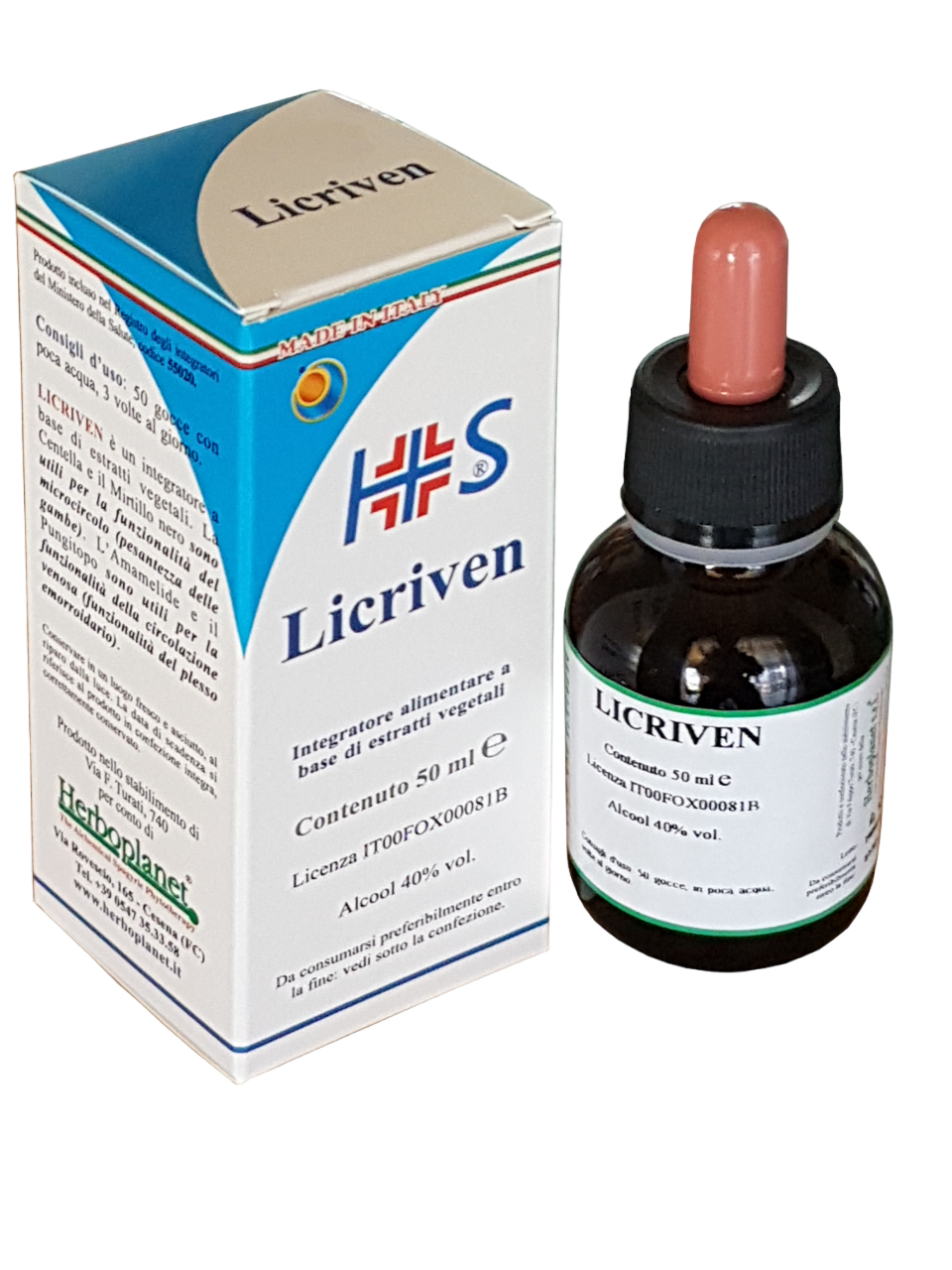
LICRIVEN is a supplement based on plant extracts.
BLACK MYRTIL is useful for the functionality of the microcirculation (heaviness of the legs).
CENTELLA contributes to the contrast of cellulite.
WITCH HAZEL is useful for the functionality of venous circulation (functionality of the hemorrhoidal plexus).
BUTCHER’S BROOM is useful for the functionality of the microcirculation (heaviness of the legs) and for the functionality of the venous circulation (functionality of the hemorrhoidal plexus).
DIRECTIONS FOR USE: it is recommended to take 50 drops in a little water 3 times a day.
WARNINGS: Keep out of the reach of children under three years of age. Do not exceed the recommended daily dose. The product should be used as part of a varied and balanced diet and a healthy lifestyle.
Available in the best pharmacies, parapharmacies, herbalists.
[content_control roles=”webinar”]
Pathology:
Hemorrhoids, cellulitis, venous states, capillary fragility, varicose ulcers, varicose veins, venous and lymphatic insufficiency, muscle cramps, chilblains, hypertrophic scars. improves the permeability, strength and circulation of the vessels. Vascular insufficiency in the lower extremities, tingling, hematomas, varicose veins, edema in the extremities, phlebitis, heavy legs. Improves drainage (normalizing it) of the lymphatic system. Tonic of the venous walls.
Notes:
CASTANEA VESCA (buds) acts on the lymphatic vessels. The lymphatic circulation (“white blood”) has an important responsibility in the symptomatology of the varicose leg. The macerate is able to reduce the phenomena of congestion and lymphatic engorgement of the lower limbs; consequently, it is an exceptional lymphatic drainer in vascular disease and edema of the lower limbs. Lymphatic stasis plays a primary role in venous insufficiency of the lower limbs and gemmotherapy has lymphatic drainage action in varicose legs greatly attenuating the symptoms responsible for edema and the painful sensation of heavy legs. Useful in vasculopathies, edema of the lower limbs, varicose veins and varicose ulcers. SORBUS DOMESTICA (buds) is specific for the veins, it tones the vein wall and fights inflammation. The macerate eliminates the congestive phenomena of venous circulation and tones the walls. Good blood thinner, its maximum tropism is at the level of venous circulation in the lower limbs. Useful in varicosities, phlebitis, vasomotor crises, varicose ulcers, hemorrhoids. The preparations based on HORSE CHESTNUT (Aesculus hippocastanum) have long been used in the therapeutic of vascular diseases (decrease in permeability and capillary fragility), in fact, it activates blood circulation and promotes venous return. If horse chestnut is taken daily, there is a reduction in the activity of enzymes responsible for the degradation of proteoglycans, thus ensuring the cohesion of the vascular wall. Nei soggetti portatori di varici la concentrazione di tali enzimi, d’origine lisosomiale, aumenta notevolmente (Rombi M., 100 Plantes Médicinales, Ed. Romart, Nice, 1991, p. 169). Horse chestnut is the main remedy as it has a phlebotonic action in venous congestion and hemorrhoidal stasis. CENTELLA (Centella asiatica or Hydrocotile asiatica) is indicated in pathologies of a circulatory nature as it is able to improve the vascular-connective trophism, restoring over time the hemodynamic balance at the level of the micro-vascular-tissue system. The plant contains triterpene derivatives (asiaticoside) with modulating properties on the development of connective tissue; regulates the growth of fibroblasts avoiding excessive proliferation with the consequent formation of keloids and hypertrophic scars; increases the amount of new collagen synthesized. Its use is useful in all dermis healing processes as it is able to regulate the quantity and quality of the newly formed connective tissue. This ensures that soft and non-hypertrophic tissues are obtained. The plant is used in the treatment of surgical sores, light burns, varicose ulcers and cellulite, as it seems they occur precisely due to a probable alteration of the vascular-connective trophism. Centella is useful for improving the symptoms related to veno-lymphatic insufficiency. Some studies have reported the effectiveness of the plant also in reducing striae gravidarum. WITCH HAZEL (Hamamelis virginiana) is used in venous insufficiency and hemorrhoidal symptoms as it has tonic-astringent and vasoregulatory action similar to that of vitamin P. The presence of flavonoids and triterpene compounds contributes to the regulation of muscle tone of the venous walls. This property means that it is useful in some disorders where it needs an astringent action: phlebitis, varicose veins and hemorrhoids. With the gaseous plethysmography technique it is observed that a compound containing Witch Hazel, Horse Chestnut and Hydraste causes an increase in venous tone in subjects with varicose veins [Rohyer R., Schmidt C.L., Semaine des Hôpitaux, Paris 57, 2009-2013 (1981) ]. BUTCHER’S BROOM (Ruscus aculeatus) contains an active ingredient called ruscogenin which has anti-oedema, anti-inflammatory, vasoconstrictive properties on microcirculation and is able to modulate capillary permeability and resistance with an action similar to that of vitamin P (M. Pedretti, Chemistry and pharmacology of medicinal plants). Due to its venotonic, anti-inflammatory and astringent properties, butcher’s broom is used as a remedy of excellence in the treatment of hemorrhoids and varicose veins. Weiss points out that butcher’s broom is effective in anorectal syndromes, especially in hemorrhoids, where there is a decongestion of the inflamed hemorrhoidal nodules which deflate thus giving the patient a sense of relief. Leclerc also reported the use of butcher’s broom in hemorrhoids reporting the experience of Caujolle and collaborators (Toulouse médical, 1952) who proved that there are considerable, rapid and lasting improvements and that in some cases they have the value of true healing . This, with the administration of 30-50 drops of a 10% hydroalcoholic solution, or with a R.E. 1/10 of butcher’s broom roots (RE of the TSA 1/5 = double concentration of the active ingredients compared to the RE 1/10). There are now numerous clinical observations that highlight the vasculoprotective and venotonic properties of the Ruscus, demonstrating the effectiveness of the phytocomplex in improving the symptoms related to venous insufficiency and hemorrhoidal crisis (Bruneton, 1993). The MYRTIL (Vaccinium myrtillus) contains an anthocyanin glucoside (blueberry) which gives it a vasoprotective and anti-edematous action. The activity of these principles is manifested above all at the level of the microcirculation, increasing the resistance of the capillaries, strengthening their walls and decreasing their permeability (vasal antipermeabilising activity); from this we can also see its action similar to that of vitamin P. Blueberry is therefore useful in the treatment of capillary fragility, capillary permeability disorders and vascular disorders. There are many clinical studies on anthocyanin-based preparations that demonstrate their efficacy at the microcirculation level. The pharmaceutical industry has also drawn from the plant world to produce preparations based on anthocyanins and blueberries to treat capillary fragility, venous circulation disorders, phlebopathy and hemorrhoids (especially pre- and postpartum). POPULUS NIGRA (gems) is an arterial antispasmodic, favors the establishment of the collateral circulation and fights trophic skin disorders. It is a protective and spasmolytic of the arterial vessel tunic, it reduces the spasm of the arteries of the lower limbs and favors the collateral circulation of compensation, it also has a modest anticoagulant and profibrinolytic action. The buds have an action on the vessel wall and regulating the sympathetic innervation, capable of reducing vasospasm and favoring the collateral circulation of compensation, thus improving the spraying and arterial blood perfusion to the advantage of the lame patient, who will be thus able to increase the distance he traveled before, without having vasospasms. Useful in arteritis. OLEA EUROPEA (young shoots) has an anti-atheromatous, vascular and coronary protective action. It has dilating action on the arteries, making them more elastic, diuretic, regressing edema and decreasing the urea level in the blood. Gemmotherapy eliminates arterial and arteriolar spasm in all arterial districts (cerebral, coronary, renal). Useful in vascular sclerosis, hyperglycemia, hypercholesterolemia, hyperlipidemia, hypertriglyceridemia, hypertension. The CANINE ROSE (young jets) has anti-inflammatory action and has the ability to rebuild the immune system.
COMPLEMENTARY REMEDIES: HERBOSOL C, RUSCUSOL, VARIXOL
[/content_control]