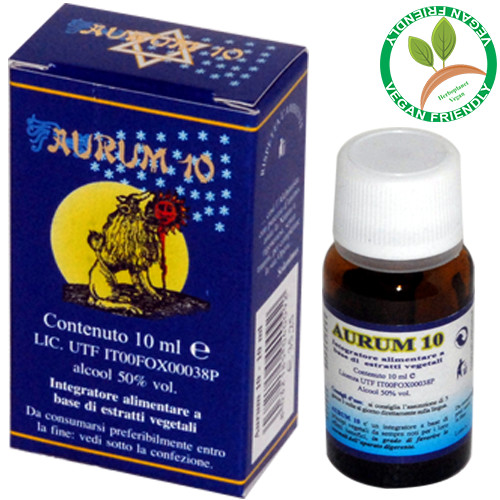
Product included in the register of supplements of the Italian Ministry of Health, code 101.
HERBAL INGREDIENTS INTAKE FOR 2 TABLETS: Garlic bulbs dry extract (Allium sativum L.) titrated 1% in Alliina 520 mg (contribution in Alliin 5.2 mg), Olive leaves dry extract (Olea europaea L.) titrated 6% in Oleuropein 520 mg (contribution in Oleuropein 31.2 mg). Bulking agent: microcrystalline cellulose. Horsetail grass dry extract (Equisetum arvense L.) titrated 2% in Silica 140 mg (contribution in Silica 2.8 mg), Hawthorn flowers and leaves dry extract (Crataegus oxyacantha auct.) titrated 3% in Vitexina 120 mg (contribution in Vitexina 3.6 mg). Anti-caking agents: silicon dioxide, magnesium salts of fatty acids. Arancio amaro frutto immaturo estratto secco (Citrus aurantium var. amara L.) titolato 6% in Sinefrina 40 mg (apporto in Sinefrina 2,4 mg ).
GLUTEN FREE – FRIEND OF VEGANS
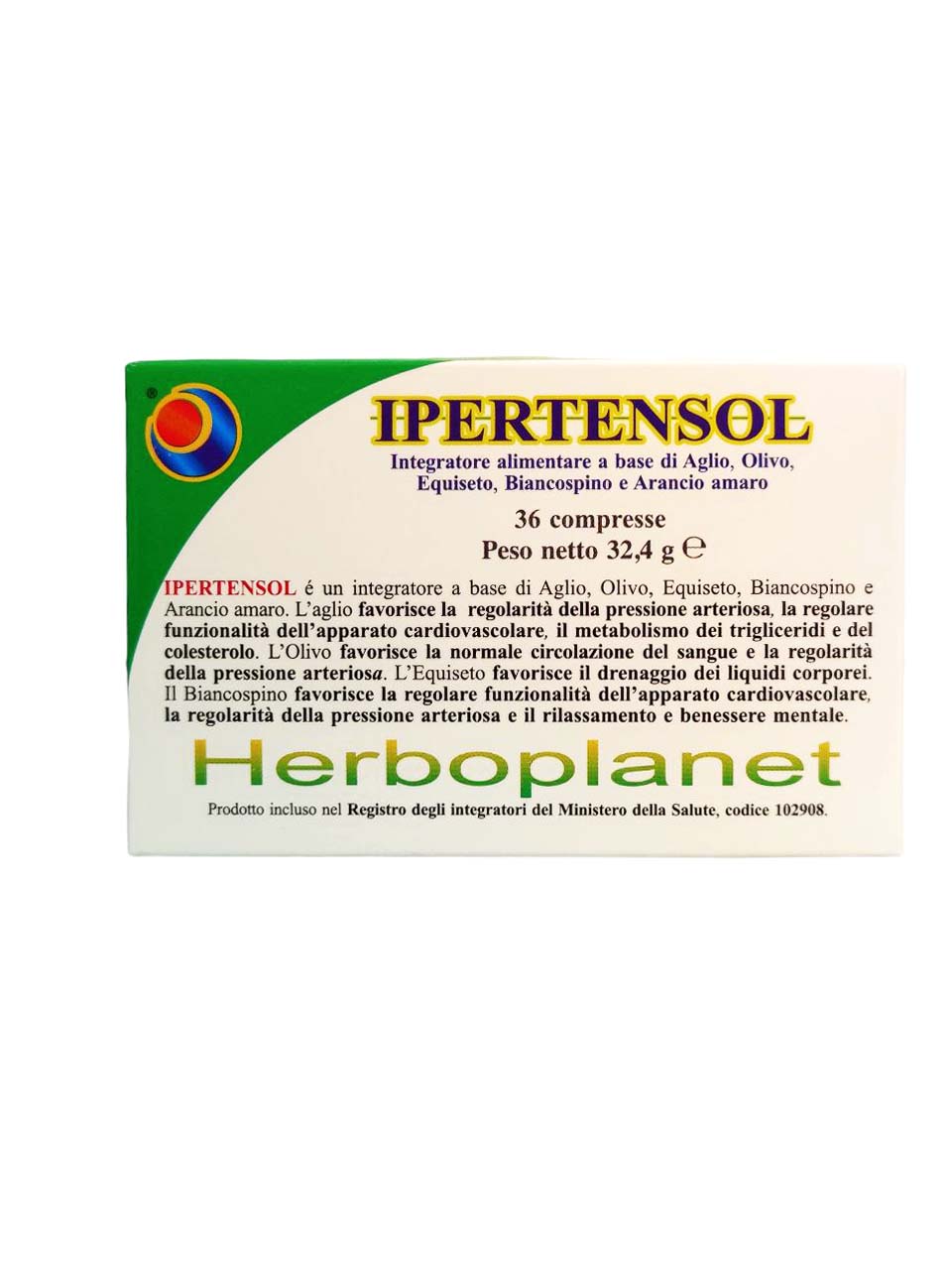
IPERTENSOL is a food supplement based on plant ingredients.
GARLIC favors the regularity of blood pressure.
OLIVE tree promotes normal blood circulation.
HORSETAIL favors the drainage of body fluids.
HAWTHORN contributes to the regular functionality of the cardiovascular system.
DIRECTIONS FOR USE: 1 tablet 1 or 2 times a day.
WARNINGS: Keep out of the reach of children under three years of age. Do not exceed the recommended daily dose. The product should be used as part of a varied and balanced diet and a healthy lifestyle. The use of the product during pregnancy, lactation and under 12 years is not recommended. Consult your doctor before use if your cardiovascular conditions are abnormal.
Available in the best pharmacies, parapharmacies, herbalists.
[content_control roles=”webinar”]
Pathology:
Arterial hypertension.
Notes:
The GARLIC bulb (Allium sativum) contains a substance called alliin which is inactive, but by crushing the bulbs it is transformed into allicin which is instead an active substance. Garlic has an important cardiovascular and hypotensive action and after adequate oral administration of therapeutic doses, a decrease in blood pressure, both maximum and minimum, is noted, due to vasodilation of the arterioles and capillaries and blood thinning. This hypotensive effect is followed by a marked cardiokinetic action due to a reinforcement of the contraction energy and a slowing of the pulse (Benigni, Capra). It has also been ascertained that garlic can help inhibit the development of sclerotic processes. A clinical study, published in 1999, showed that garlic is able to reduce the formation of atherosclerotic plaques in a certain percentage of subjects, which occurs with age [Orekhov A.N., Grunwald J., Effects of garlic on atherosclerosis, Nutrition 13, (1997); Koscienly J., Klussendorf D. et al., The antiatherosclerotic effect of Allium sativum, Atherosclerosis 144, 237-249 (1999)]. Antiplatelet and fibrinolytic properties have been ascertained (activities similar to aspirin: it reduces the risk of thrombosis and therefore of heart attack), the action would be linked to the ajoenis which interact directly with the platelet receptors of fibrinogen and lipoxygenase [Apitz-Catro R., Ledezma E., Ascalante J., Biochem. Biophys. Res. Commun. 41, 145-150 (1986)]. The OLIVE TREE (Olea Europea) with its lactone glucosides such as ellenolide and oleouropein contained in the leaves acts, by now it is certain, as a hypotensive vasodilator localizing its action mainly in the arteries and coronaries. This action, which can be evaluated in cases of supraventricular tachycardia associated with hypertension, makes olive preparations appreciable hypotensive and coronary protectors. This action would be assisted and enhanced by flavonoids such as luteolin-4-glucoside and apigenin, also contained in the leaves. The fact that the vasodilator action of the plant is also manifested on the coronary arteries has led some authors to suppose that it is a muscular rather than a nervous action; that is to say that the hypotensive action would be consequent to a vasodilatation due to a myolytic effect of the active ingredients of the olive tree on the muscle fibers (Inverni Della Beffa, Manual of phytotherapy, Milan 1951). It reduces blood viscosity and facilitates diuresis (Penso G., Medicinal plants in medical therapy, IIa ed. OEMF, Milan 1989, pp. 143-146). Its use gives benefits in hypertensive subjects with notes of atherosclerosis (Benigni). The polyunsaturated fatty acids contained in the plant (which reduce cholesterol) would lead to the formation of thrombaxane and prostaglandins involved in guaranteeing the integrity of the vessels. The hypotensive effect appears after about 20-30 minutes from administration and increases gradually, the therapy must be followed for a prolonged period. Of HORSETAIL (Equisetum arvense) or horsetail, we are interested in some of the active ingredients it contains, namely isoquercitin and kaemferol, which have a strong diuretic action, assisted by mineral ions also present in the plant. HAWTHORN (Crataegus oxyacantha) contains flavonoids (rutin, quercitin), triterpenes, cyanogenic glucosides, amines (trimethylamine, only in the flower), polyphenols, coumarins, tannins. It has an important thrombophilic, anti-sclerosing activity. It is an excellent regulator of heart movements, which it slows down. It tones the myocardium, more specifically at the level of the left heart. The flowers are rich in quercitin (active substance). It is a coronary vasodilator. It is also used in the treatment of chest angina and coronary artery problems. The plant acts on the cardiovascular system on the one hand by dilating the muscles of the vessels, in particular the coronary ones, so by decreasing the peripheral resistance it causes a hypotensive action, on the other by acting directly on the myocardium with a positive inotropic action. Hawthorn has positive inotropic and negative chronotropic properties (strengthens and slows myocardial contractions), as well as positive dromotropic (lower conductivity), bathmotropic (lower excitability). The flowers of the BITTER ORANGE (Citrus aurantium bitter variety) are provided with an essential oil very rich in linalool, geraniol and nerol, terpenic alcohols which impart to the flowers not only a delicate fragrance, but also a pharmaceutical action. Bitter orange flowers have a sedative and antispasmodic action and are therefore indicated in states of nervous excitement, regulate the heart rhythm and calm palpitations.
COMPLEMENTARY REMEDIES: CARDIASOL, MAGSOL 5 EXTRA, SEDASOL, NEUROSOL
[/content_control]