WITHOUT • Parabens • Silicones • Dyes • BHA/BHT • Animal derivatives
INGREDIENTS: Water, Solum Fullonum, Glycerin Peg 100 Stearate, Glyceryl Stearate, Prpylene Glycol, Prunus Amygdalus Dulcis Oil, Glycerin, Hydrogenated Polyisobutene, Alcohol, Harpagophytum Procumbens Root Extract, Arnica montana Flower Extract, Heilanthus Annus Seed Oil, Cetearyl Alcohol, Ricinus Communis Seed Oil, Cetyl Alcohol, Kaolin, Hedera Helix Leaf Extract, Fucus Vesiculosus Extract, Aesculus Hippocastanum Seed Extract, Ruscus Aculeatus Extract, Menthol, Tocopherol, Mentha piperita Oil, Pinus sylvestris Leaf Oil, Salvia Officinalis Oil, Thymus Vulgaris Oil, Lavandula Angustifolia Herb Oil, Cupressus Sempervirens Leaf Oil, Citrus Medica Limonum Peel Oil, Phenoxyethanol, Capryl Glycol, Eugenol*, Limonene*, Linalool*, Citral*, Geraniol*.
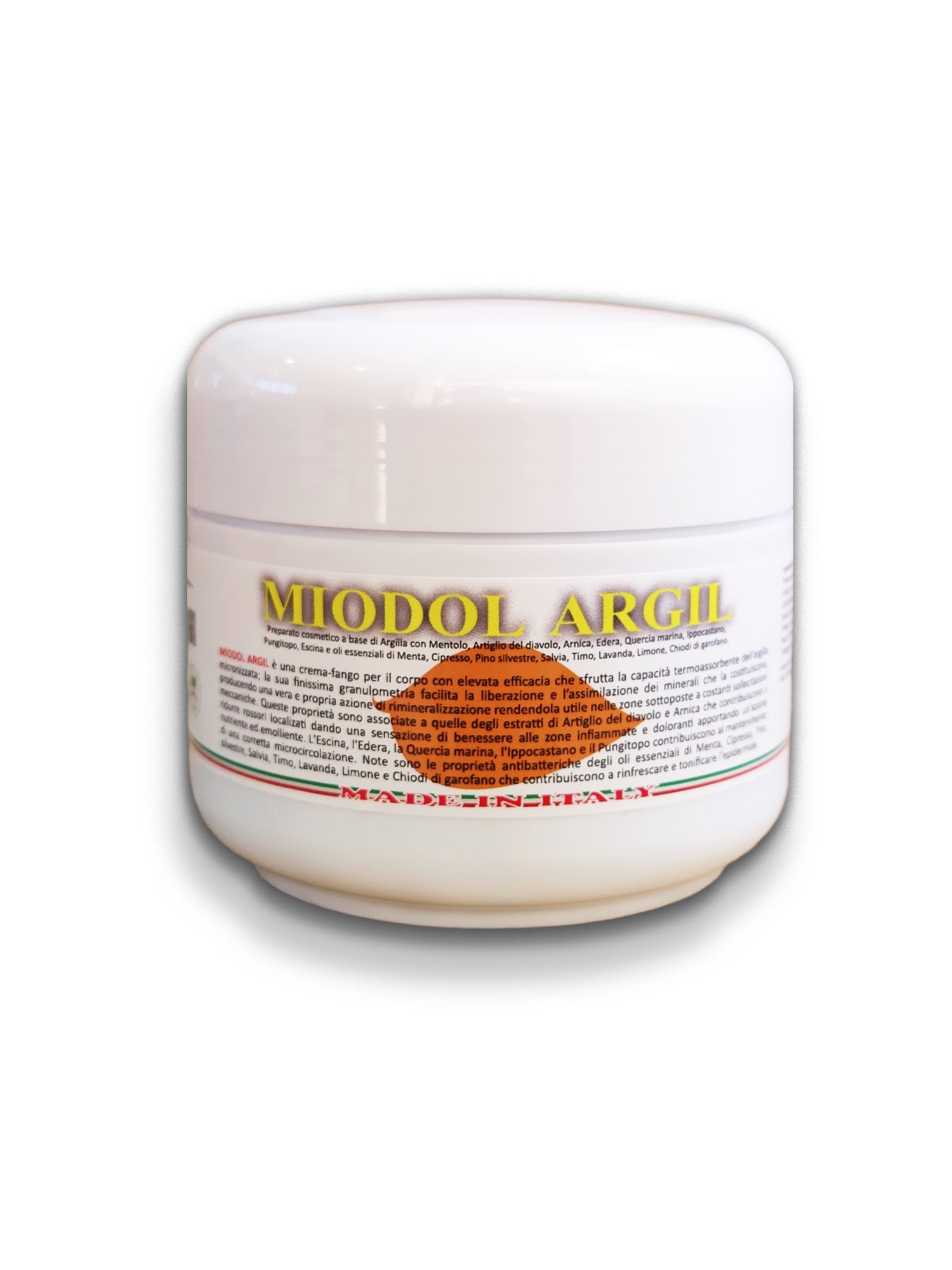
MIODOL ARGIL is a highly effective mud-cream for the body that exploits the heat-absorbing capacity of micronized clay; its very fine granulometry facilitates the release and assimilation of the minerals that make it up, producing a real remineralization action making it useful in areas subjected to constant mechanical stress. These properties are associated with those of extracts of Devil’s Claw and Arnica that help reduce localized redness giving a feeling of well-being to inflamed and painful areas providing a nourishing and emollient action. Escin, Ivy, Sea Oak, Horse Chestnut and Butcher’s Broom contribute to the maintenance of proper microcirculation. Notes are the antibacterial properties of the essential oils of Mint, Cypress, Scots pine, Sage, Thyme, Lavender and Lemon which help refresh and tone the epidermis.
Available in the best pharmacies, parapharmacies, herbalists.
[content_control roles=”webinar”]
Pathology
Notes
ARNICA is limited almost exclusively to external use as a revulsive and used with remarkable results as an anti-ecchymotic and resolving in rheumatic diseases. The plant contains: triterpene alcohols, which are spasmolytic at the level of smooth muscles, especially vascular, allowing the destruction of tissues subject to inflammation; sesquiterpene lactones (arnicolides), which are antihistamines, antineuralgic also counteracting the inflammatory state; amine,which lock theinflammation due to trauma and serous or blood effusions, increasing serous resorption and favoring the action of cells responsible for the destruction of biological fragments of necrotic nature. In essence, Arnica montana blocks inflammation due to trauma with serous effusions, increases the reabsorption of the same and stimulates the function of the cells responsible for the distribution of biological enzymes of necrotic origin. DEVIL’s CLAW (Harpagophytum procumbens), in liposomal form, has a faster and deeper anti-inflammatory action. It has anti-rheumatic properties, contains a glucoiridoid with analgesic properties comparable to those of synthetic anti-inflammatories without possessing its antiarthritic and spasmolytic action (Der Marderosian, A. (ed.). The Review of Natural Products. St. Louis: Facts and Comparisons. 1999. Wegener T. Therapy of degenerative diseases of the musculoskeletal system with South African devil’s claw. Wien Med Wochënschr 1999; 149: 254-257). Although there are still few trials conducted on humans, a controlled clinical study was published some time ago, conducted on 197 patients who presented with recurrent episodes of low back pain, which demonstrated that treatment with Devil’s Claw is more effective than placebo ( Chrubasik S, Junck H, Breitschwerdt H, Conradt C, Zappe H. Effectiveness of Harpagophytum extrac WS 1531 in the treatment of exarcebation of low back pain: a randomized, placebo-controlled, double-blind study. Eur J Anaesthesiol 1999; 16: 118-129). Preparations based on HORSE CHESTNUT (Aesculus hippocastanum) have long been used in the treatment of vascular diseases(decrease in permeability and capillary fragility), in fact, activates blood circulation and promotes venous return. With horse chestnut there is a reduction in the activity of enzymes responsible for the degradation of proteoglycans, thus ensuring the cohesion of the vascular wall. In subjects with varicose veins the concentration of these enzymes, of lysosomal origin, increases considerably (Rombi M., 100 Plantes Médicinales, Ed. Romart, Nice, 1991, p. 169). Horse chestnut is the main remedy as it has a phlebotonic action in the venous congestion. The BUTCHER’s BROOM(Ruscus aculeatus) contains an active substance called Ruscogenin which has properties anti-edema, anti-inflammatory, vasoconstrictors on microcirculation and is able to modulate permeability and capillary resistance with action similar to that of vitamin P (M. Pedretti, Chemistry and pharmacology of medicinal plants). Due to its venotonic, anti-inflammatory and astringent properties, Ruscus is used as a remedy of excellence in the treatment of hemorrhoids and varicose veins. There are now numerous clinical observations that highlight the vasculoprotective and venotonic propertiesof the Butcher’s Broom. Ivy (Hedera helix) has been known for a very long time for its effective and beneficial sedative, purifying and antispasmodic properties. It performs an excellent action as an anesthetic, antineuralgic and calming. Its astringent and vasoconstrictive actions facilitate the reabsorption of liquids stagnating in the tissues, it is also useful in the treatment of muscular, rheumatic and neuralgic pains. It promotes lymphatic and circulatory function, facilitating the healing process of edema. The essential oils of Mentha piperita, Cupressus sempervirens, Pinus sylvestris, Salvia officinalis, Thymus vulgaris, Lavandula angustifolia, Citrus limonum, Eugenia caryophyllus, enhance the anti-inflammatory and analgesic action of clay.
[/content_control]