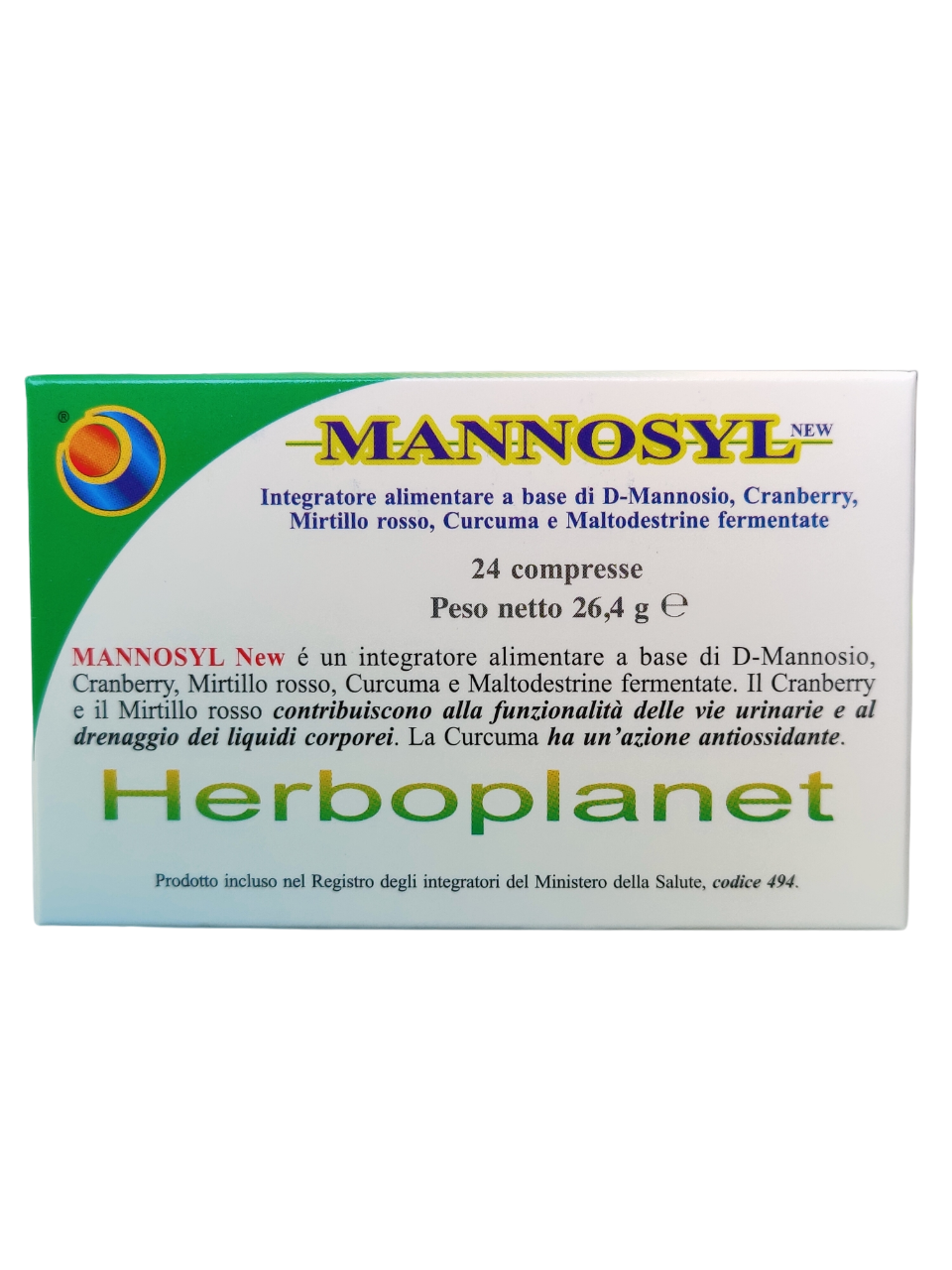
Product included in the register of supplements of the Italian Ministry of Health, code 494.
INTAKE INGREDIENTS FOR 2 TABLETS: D-Mannose 600 mg. Bulking agent: microcrystalline cellulose. Cranberry fruit dry extract (Vaccinium macrocarpum Aiton) standardised to contain 30% Proanthocyanidins 400 mg (contribution in Proanthocyanidins type A 120 mg), Cranberry leaves dry extract (Vaccinium vitis-idaea L.) 400 mg, Turmeric rhizome dry extract (Curcuma longa L.) standardised to contain 95% Curcuminoids 100 mg (Curcuminoid intake 95 mg). Fermented maltodextrin 100 mg (contribution of the following enzymes: Amylase, Protease, Concentrated Protease, Glucoamylase, Lipase, Cellulase, Lactase, Endophytase). Anti-caking agents: silicon dioxide, magnesium salts of fatty acids.
GLUTEN FREE – FRIEND OF VEGANS
MANNOSYL NEW is a food supplement based on D-Mannose, Cranberry, Cranberry, Turmeric and fermented Maltodextrins.
CRANBERRY and RED MYRTLE contribute to the functionality of the urinary tract and the drainage of body fluids.
TURMERIC has an antioxidant action.
DIRECTIONS FOR USE: 1 to 2 tablets a day, to be swallowed with water.
WARNINGS: Keep out of the reach of children under three years of age. Do not exceed the recommended daily dose. The product should be used as part of a varied and balanced diet and a healthy lifestyle. Do not use during pregnancy and lactation. In case of impaired liver function, biliary or biliary tract stones, the use of the product is not recommended. If you are taking any medications, consult your doctor. Do not use for prolonged periods without consulting your doctor.
Available in the best pharmacies, parapharmacies, herbalists.
[content_control roles=”webinar”]
Pathology:
Notes:
D-MANNOSE: the Escherichia coli bacterium is covered with micro cilia equipped with lectins which bind to the mannose present on the mucous membranes of the bladder or urinary tract. In the majority of cases after the initial infection, recurrences are due to the survival of the bacterium in the mucous membranes of the bladder where it remains in a latent state. Under certain favorable conditions, it can reactivate and multiply. This is where the resistance of the bacterium comes from and every time it becomes more and more resistant. Escherichia coli tends to bind to the mannose molecules present in the mucous membranes, therefore the d-mannose takes the place of the tissue mannose molecules, thus preventing the bacteria from clinging to the mucous membranes and slipping away with the urine.
FERMENTED MALTODEXTRINS: mine of digestive enzymes. There is a close relationship between digestive enzymes and other antioxidant and systemic enzymes. When there is a lack of digestive enzymes, leukocytes cease to function as immune agents and give up their enzymes to the digestive process. Subito dopo un pasto abbondante saremo quindi più vulnerabili agli attacchi virali e alle infezioni e in generale le insufficienze enzimatico-digestive possono indebolire il nostro sistema immunitario. L’integrazione di enzimi fungali ad ampio spettro quindi, oltre ad avere effetti benefici diretti sulla digestione, agisce anche sulla funzionalità immunitaria.
CRANBERRY: (Vaccinium macrocarpon Aiton), belonging to the Ericaceae family, is an evergreen plant of small size of American origin. The fruits have disinfectant and anti-inflammatory activity and are particularly active in urinary tract infections (cystitis). In particular, this would happen thanks to the type A pro-anthocyanidins (PACs) of which the fruit is rich, which act by adhering to the tissues and forming a sort of “protective molecular layer” which contrasts and rejects the adhesion of pathogenic bacteria. Initially, it was hypothesized that the antiseptic action of Cranberry in the urine was related to the ability to acidify the urine, making it less hospitable for the proliferation of bacteria. Subsequent experimental studies have shown, however, that the main mechanism of action does not depend so much on the ability to acidify urine, but rather on inhibiting the adhesion of fimbriate Escherichia coli to urinary epithelial cells. The action seems to be due to proanthocyanidins, polyphenols which selectively inhibit the adhesions produced by bacteria, reducing bacterial adhesion to uroepithelial cells. The most active proanthocyanidins in this sense appear to be those of type A (PAC), which are, in fact, the majority in the “blueberry phytocomplex”. The cranberry also exerts this effect against other pathogens of the urinary tract.
RED MYRTLE: (Vaccinium Vitis Idaea L.) the leaves are rich in arbutin (from 4 to 9%) which has a strong antibacterial activity in the urinary tract. Arbutin is hydrolysed by enzymes in the intestine, thus releasing hydroquinone, which is in turn eliminated from the urinary tract after glucuro and hepatic sulphate conjugation. The hydroquinone metabolites reach the renal pelvis and the bladder, where, in an alkaline environment, more hydroquinone is released, so that its antibacterial properties are manifested and this after 3 or 4 hours from the administration of the product. From here it can be understood that proceeding with the alkalinization of the urine favors the plant in carrying out its action. This can be done simply by taking 4-8 grams of sodium bicarbonate per day. The bacteriostatic properties of hydroquinone against some bacterial strains such as Escherichia coli, Staphylococcus aureus and Proteus vulgaris, have been able to be demonstrated in vitro (Bruneton J, 2009, Pharmacognosie …., op. cit., pag. 280 ).
TURMERIC: (Curcuma longa L.) has anti-inflammatory and antioxidant properties due to its main active ingredient (50-60%); curcumin (diferoylmethane). Its anti-inflammatory property is manifested both in the acute phase of inflammation and in the now chronic one. Curcumin acts both on the inhibition of cyclooxygenases (path where non-steroidal anti-inflammatory drugs – NSAIDs) and on the inhibition of lipooxygenases (path where steroid anti-inflammatory drugs act). Turmeric is an anti-inflammatory that has very low toxicity; something not to be underestimated. Turmeric also has antioxidant properties and lately its immunomodulatory property has also been highlighted. Another interesting property given by the curcuminoids contained in turmeric is bactericidal and antiviral.
[/content_control]