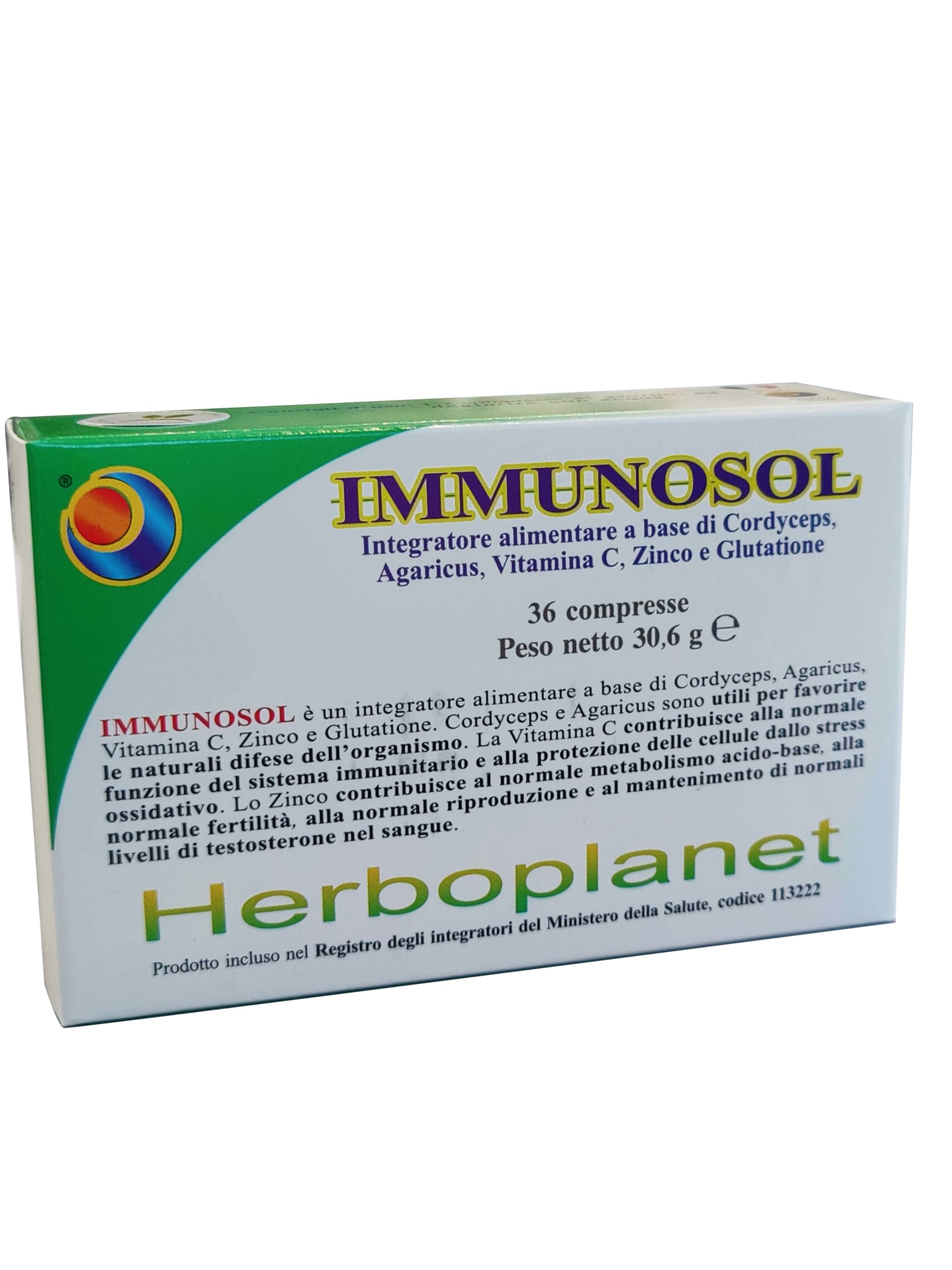
Product included in the register of supplements of the Italian Ministry of Health, code 113222.
INGREDIENT INTAKE FOR 2 TABLETS: bulking agent: microcrystalline cellulose. Cordyceps sporoforo (Cordyceps sinensis (Berk.) Sacc.) dry extract standardised to contain 40% polysaccharides 350 mg (contribution in Polysaccharides 140 mg), Agaricus sporophore (Agaricus Blazei Murril) dry extract titrated to 10% in Polysaccharides 350 mg (contribution in Polysaccharides 35 mg), Vitamin C (L-Ascorbic Acid) 80 mg (100% NRV*), Zinc sulphate 66 mg (contribution in Zinc 15 mg – 150% NRV*), L-Glutathione 50 mg. Anti-caking agents: silicon dioxide, magnesium salts of fatty acids. – *NRV: Nutrient Reference Values.
GLUTEN FREE – FRIEND OF VEGANS
IMMUNOSOL is a food supplement based on Cordyceps, Agaricus, Vitamin C, Zinc and Glutathione.
CORDYCEPS has a tonic action, metabolic support and promotes the body’s natural defenses.
AGARICUS promotes the body’s natural defences.
VITAMIN C contributes to the normal function of the immune system and to the protection of cells from oxidative stress.
ZINC contributes to normal acid-base metabolism, normal fertility, normal reproduction and maintenance of normal testosterone levels in the blood.
DIRECTIONS FOR USE: 1 or 2 tablets a day to be swallowed with water.
WARNINGS: Keep out of reach of children under three years. Do not exceed the recommended daily dose. The product should be used as part of a varied and balanced diet and a healthy lifestyle.
Available in the best pharmacies, parapharmacies, herbalists.
[content_control roles=”webinar”]
Pathology:
Sexual impotence, sterility. Weak immune system, reduced immunological functions. Atherosclerosis, arteriosclerosis. Hepatitis C, cirrhosis of the liver. Hyperglycaemia. Dermatitis, prostatitis, asthma, chronic bronchitis, TB, arrhythmias, AIDS, macular degeneration, night blindness, acne, leukemia, Hodgkin’s disease.
Notes:
CORDYCEPS SINENSIS (Caterpillar fungus) is a mushroom that grows in the mountainous regions of China and Tibet, characterized by a powerful toning action and believed to be able to increase physical resistance, mental energy, sexual vigor and longevity. The discovery of the properties of this mushroom is due to the ancient Tibetan shepherds of yaks and goats, who, having noticed a vigorous behavior of their animals after grazing on the great altitudes of the plateaus, have researched the cause, discovering that together with the common grass, another particular “vegetable” grew, also grazed by their animals. From that moment began the experimentation and discovery of the medicinal powers of the mushroom. It is believed to be able to improve athletic performance by increasing systolic flow. Studies and experiments have been carried out to demonstrate its effects on human performance and it has been discovered that with the intake of Cordyceps increases adenosine triphosphate (ATP) at the cellular level, a molecule present in all living organisms, for which it represents the main form of energy storage immediately available. When ATP loses a phosphate it becomes Adenosine diphosphate (ADP) and the energy released by breaking the bond is immediately available for all body processes that require energy such as muscle contraction, nerve impulses, protein synthesis and cell divisions. An increase in cellular ATP means a real increase in energy, not as perceived by the use of stimulants such as caffeine, ephedrine and amphetamines. With amphetamines, the brain receives altered information on the availability of energy to consume, but when it is depleted, the body is forced to resort to reserves. Cordyceps sinensis is an excellent tonic of sexual life. It is an aphrodisiac tonic, but not as a “one shot at a time”, like the blue pills, but as a drug that permanently improves the sex life by helping health. Gratifying results have also been observed in the case of erectile disorders of vascular origin. In recent years, researchers have carried out countless researches to broaden the knowledge on the effects of this mushroom: it is attributed a protective capacity at the kidney level, to prevent the damage caused by certain antibiotics and a protective capacity on the immune system and liver disorders. During an important conference held in Rome, Italian and Chinese professors met, some of whom are experts in acupuncture and in treatment with traditional Chinese medicines, such as Professor He Jialang, professor at Zhejiang Chinese Medical University and well-known acupuncturist also in Italy. Jialang, together with the well-known Italian immunologist Professor Samuele Paparo, of the second Faculty of Medicine of La Sapienza in Rome and two other Chinese academics, father and son (Yueai Ke and Chuaiti Ke), of the Institute of Medical Research of the University of San Diego in California and Professor Yong Sheng Fan of Zhejiang Medical Chinese University, have carried out research on the mushroom to demonstrate its surprising properties. Cordyceps sinensis has received increasing attention from chemists, biologists and doctors. This mushroom contains cordycepiacid and ergosterol, components which, in combination, increase the functionality of the immune system. The secret of this mushroom lies in being able to perfectly balance Th1 and Th2 lymphocytes, which are very important for the body’s immune responses. Cordyceps is able to reduce the negative effects of innumerable diseases through the increase of the immune activity thus strengthening the resistance to bacteria and viruses. It has an effective action in cases of leukopenia and cellular damage caused by radiotherapy and chemotherapy. Increases SOD (Superoxide Dismutase), an enzyme that eliminates the harmful and highly reactive free radical form of O2 (superoxide). Aerobic bacteria are usually protected from the lethal effect of superoxide by this enzyme. The role of Superoxide Dismutase (SOD) is to accelerate the dismutation of the toxic superoxide radical (O2), produced in oxidative processes, into hydrogen peroxide and molecular oxygen. Without oxygen we could not live, our cells use oxygen as the final acceptor of electrons in respiration, in this way they are able to obtain much more energy from food than they would in anaerobic conditions. However, oxygen is also a dangerous element, reactive forms of oxygen such as the superoxide radical (oxygen with an extra electron) can escape the enzymes of cellular respiration and cause disasters in the cells. Superoxide can also cause mutations in DNA or attack enzymes that synthesize amino acids or other essential molecules. This is not a negligible danger, research has shown that about every 10,000 electrons transferred along the respiratory chain in Escherichia coli cells, three electrons end up producing superoxide instead of following their normal path up to the enzyme which transfers them to the oxygen to produce water. To avoid this occurrence, most cells produce the enzyme Superoxide Dismutase (SOD) which transforms the superoxide into less dangerous molecules (oxygen and hydrogen peroxide). As the name implies, the SOD enzyme breaks down superoxide. Dismutation is a particular type of reaction in which two opposite reactions take place simultaneously, an oxidation and a reduction, on two equal molecules. The SOD enzyme acts on two superoxide radicals, strips away the extra electron from the first and transfers it to the second, in this way one of the two molecules finds itself with one electron less and therefore becomes molecular oxygen O2, the other finds itself with an extra electron and, after having linked two H+ ions, it becomes hydrogen peroxide H2O2. Since hydrogen peroxide is also a dangerous compound, the cell tries to destroy it as quickly as possible using the enzyme Catalase which converts hydrogen peroxide into water and molecular oxygen. The enzyme Superoxide Dismutase (SOD) has recently gained notoriety as being implicated in Amyotrophic Lateral Sclerosis, a serious degenerative disease that leads to the selective death of motor neurons in the central nervous system and spinal cord leading to a progressive and irreversible paralysis in a few years. Most cases of ALS occur in adulthood and its cause was unknown until recently. About ten percent of ALS cases are hereditary, caused by genetic mutations that are passed on to children. Recent research has shown that one of these mutations is found in the gene that codes for the SOD enzyme. Scientists are now studying the role of the SOD enzyme in this disease hoping to discover something that will lead to new treatments and more effective cures. This medicinal mushroom is extremely rich both in beta-glucans, recognized as helpful in cancer therapies, and in polysaccharides. The latter are long chains of sugars with many sections of oxygen inside and when broken down by the body, the oxygen molecules are released and absorbed at the cellular level. We know that cancer in all its forms is unable to exist in an oxygen-rich environment and that, without adequate oxygen levels, the body finds itself falling into degenerative states that favor cancer, heart disease, immune disorders and diabetes, allowing numerous viral diseases such as hepatitis C, Lyme disease and others to take hold. The action at the level of the respiratory system manifests itself through the relaxation of the bronchial and bronchiolar muscles, facilitating the passage of air and breathing, increasing the blood flow at the muscle level, explaining the action on asthmatic manifestations, chronic bronchitis and tuberculosis. Polmoni di animali, lesi da diversi tipi di cause, hanno riottenuto la loro elasticità dopo essere stati trattati con il Cordyceps sinensis. Chemistry has only confirmed what doctors who treat patients with the classic plants of traditional Chinese medicine have known for millennia. At the liver level, Cordyceps acts not only as a cellular protector, but also in cases of hepatitis and cirrhosis, while at the heart level, its action extends to cardiovascular disorders and in cases of hypertension.
Trials carried out in China have shown that:
· rinforza la resistenza e migliora la qualità della vita;
· improves the state of fatigued patients;
· stimulates the physical strength and resistance of patients suffering from respiratory or cardiovascular diseases;
· has anti-arrhythmic effect;
· promotes lung function;
· relieves the symptoms of patients suffering from respiratory diseases and in particular asthmatics;
· increases the aerobic capacity of elderly patients, protects the heart from the offensive effect of uabain (toxic substance used as a heart stimulator);
· reduces oxidative damage by trapping oxygenated free radicals;
· increases the rate of intracellular ATP and the use of oxygen;
· improves cold tolerance;
· increases the rate of SOD (Superoxide Dismutase);
· improves the autoimmune system;
· protects the kidneys from toxins;
· protects the liver from toxins;
· has anti-rejection effect in corneal transplantation;
· has antibiotic effect;
· inibisce la contrazione della muscolatura liscia.
AGARICUS BLAZEI Murill (ABM) is a famous edible medicinal mushroom native to a small village, Piedade, in the highland areas of the Atlantic forest near San Paulo in Brazil and was discovered by the Japanese researcher Takatoshi Furumoto. It is traditionally used for the prevention of various diseases, including: cancer, hepatitis, atherosclerosis, hypercholesterolemia, diabetes, dermatitis, heart disease, etc. Due to its health effects, the mushroom was brought to Japan in the mid-1960s and subjected to biomedical research. ABM is rich in immune-modulating substances, such as β-glucans and proteoglycans. Japanese researchers experimentally demonstrated both in vivo and in vitro the anti-infection and anti-tumor immunostimulatory effects in mice. The most biologically active metabolites can be extracted from the fruiting body in different stages of ripening and in particular it is believed that the polysaccharide phytocomplex is specifically responsible for the production of interferon and interleukins which promote and stimulate the immune function in the body by activating macrophages , neutrophils and lymphocytes. This activation is caused in particular by β-glucans which can modulate carcinogenesis at different levels and/or can act at the same level through different mechanisms. Responses to polysaccharides are likely mediated by several receptors that may be present on specific subsets of cells and initiate distinct responses. A combination of these responses could exert a tumor inhibition, through a synergistic action. In vitro studies have shown that ABM extracts can increase some biological activities or inhibit others. Mycelium extracts show induction of TNF α, (tumor necrosis factor α) and interleukins IL-8-12,1,10, secretion of nitric oxide, stimulation of cytotoxic activity achieved through higher production of IFN γ (interferon γ ) and changes in gene expression. ABM extracts have been shown to have antioxidant, fibrinolytic and stimulatory activities on immature dendritic cells obtained from rat bone marrow. ABM also causes a particular increase in mRNA for chemokine ligands and for cyclooxygenase. Studies conducted indicate other potential pharmacological activities of ABM extracts, in particular on triglyceridemia, atherosclerosis and hyperglycemia. In patients affected by hepatitis C, an 80% decrease in γ GTP was found after the use of Agaricus blazei extracts. In addition to the polysaccharides, another compound has been identified in the lipid fraction, egosterol, which has antitumor activity. Pyroglutamate is another substance which not only has antitumor and antiangiogenic activity, but which also has an inhibitory effect on the reduction of immunological functions in experimental tumors. These two mushrooms (Cordyceps sinensis and Agaricus Blazei) are currently used by the pharmaceutical industry, as well as dietary supplements by more informed consumers who are looking for alternatives to more conventional treatments for cancer, AIDS and other immune system related problems.nitario. GLUTATHIONE (reduced l-glutathione) is the most powerful and important of the antioxidants produced by the body. Glutathione in reduced form, being a low molecular weight tripeptide, can be easily absorbed in the intestine. It fights aging through two main ways: the intestine and the circulatory system. It protects the cells, tissues and organs of the body managing to keep it young. Glutathione is a combination of the three amino acids (tripeptide) cysteine, glutamic acid and glycine. Its detoxifying action is carried out at different levels: thanks to its ability to chelate (chelage = ability of one element to bind to another) heavy and toxic metals such as lead, cadmium, mercury and aluminum and transport them away by eliminating them from the body, it has great detoxifying capacity also against toxic substances such as drugs, alcohol, tobacco, etc., in order to make their elimination easier and faster. In fact, it prevents these poisons from binding to the -SH groups of tissue proteins and enzymes. It favors the availability of iron by neutralizing the toxic effect of exogenous substances (nitrites, nitrates, derivatives of benzene, toluene, aniline, etc). 25-30 mg of glutathione per day are sufficient to detoxify from dangerous fats present in foods. Numerous researches show that reduced glutathione is able to protect the immune system. With aging, the concentration of glutathione present in the body decreases, a similar lowering of the endogenous level of glutathione is found in numerous diseases including AIDS (Kameoka M. et Al. 1996, Marmor M.et Al.1997 , etc). By increasing the level of glutathione we can therefore have a positive effect on the immune system. White blood cells are particularly sensitive to changes in glutathione concentration, with important effects on the immune response (Droge W. et Al. 1994, Villa P. et Al. 2002). Also leukocyte chemotaxis is influenced by the level of glutathione (Elferink J.G. – De Koster B.M.,1991). The use of glutathione in immunodeficiency diseases such as AIDS is the subject of a very large number of international studies. A great deal of research has been carried out on the role of glutathione in neurodegenerative pathologies such as Parkinson’s disease and Alzheimer’s, in fact the brain is particularly sensitive to the damage induced by free radicals, because due to its activities it already produces many more radicals free compared to any other fabric. Glutathione is the most powerful cerebral antioxidant (Gutman J.), in subjects with Parkinson’s there is actually a low level of glutathione in the cerebral substantia nigra, which is the elective site of the most important modifications induced by the disease. In numerous other neurodegenerative diseases as well as in traumatic injuries and in some mental illnesses such as schizophrenia, the same alterations in the concentration of glutathione and dopamine have been found. In Alzheimer’s in particular, an increased activity of the enzyme glutathione peroxidase has been found, which intervenes in the destruction of peroxide radicals, which would demonstrate a higher production of these radicals in Alzheimer’s (Anneren G. et Al., 1986 ). Conversely, such an increase has not been found in dementia due to vascular causes (Licastro F. et Al., 2001). Also in Alzheimer’s disease, a decrease in the glutathione content in male patients’ red blood cells was found (Liu H. et Al., 2004).
In these cases the administration of Glutathione is positive:
a) because it increases the sensitivity of nerve centers to dopamine
b) for the energetic anti-oxidant action of reduced glutathione.
According to some authors, the improvement observed in these cases would be due to the chelating capacity of glutathione against toxic metals, such as mercury for example, which would have accumulated in the brain (Perlmutter D., Summers W. K., 2001). VITAMIN C strengthens the body by strengthening the function of phagocytes, increasing the production of antibodies and destroying oxygenated free radicals (hydroxyl radical, superoxide radical, oxygen radical). Vitamin C intervenes in the processes of cellular respiration, in the development of fibroblasts, in the formation of adrenal hormones, also stimulating the synthesis of interferon and the biosynthesis of carnicine. Another interesting action of Vitamin C is the ability to favor the assimilation of iron, increasing the rate of hemoglobin, zinc, calcium, magnesium, etc., counteracts the effects of toxic substances, ionizing radiations and intervenes in the transport of oxygen and electrons, essential for the vital activities of all cells. The ZINC it would exert a neuroprotective role, as it would block the depletion of glutathione, which is calcium dependent, in astrocytes and neurons (Andrey Y. et Al., 2003). Zinc is known for its protective properties against diseases and the immune system. It participates in the Krebs cycle and energy production. Zinc has recently been found to block the progressive decrease in vision in the elderly. It is thought to increase sexual potency in men due to its ability to regulate testosterone in the prostate. High doses of zinc have been recommended for the prevention and treatment of prostate enlargement. Zinc gives positive results in the prevention and treatment of infertility, it also promotes the development and maturity of the sexual organs. Zinc may play a role in protecting against cancer and aiding in the healing of gastric ulcers. Taking zinc supplements keeps the immune system healthy and is beneficial in the aging process. Infection-fighting T-helper lymphocytes increase with zinc intake, which is particularly interesting for AIDS patients. Zinc is able to stop macular degeneration, which causes irreversible blindness in the elderly, it helps eliminate cholesterol deposits and for this reason it is successfully used as an adjuvant in the treatment of atherosclerosis. Important in the synthesis of DNA, a fundamental substance that carries all the hereditary characters and directs the activities of every single cell, a fundamental element for the taste buds and for the proper functioning of the sebaceous glands of the skin, it can also contribute to a rapid healing of scars or from any damage to the arteries, which can relieve symptoms caused by rheumatoid arthritis. It is believed that the cause of acne vulgaris in adolescents is due to a zinc deficiency and therefore successfully treatable with the administration of supplements containing this mineral. Zinc can promote hair regrowth in people with alopecia areata totalis. Its administration can give relief to patients suffering from Hodgkin’s disease and leukemia, the same is also used in the treatment of liver cirrhosis and alcoholism. It is effective in the treatment of diabetes, thanks to the regulatory effects of insulin in the blood. Zinc deficiency has also been found in the generalized pustular form of psoriasis, pressure ulcers, bullous pemphigoid, Crohn’s disease, after certain surgeries, and sickle cell anemia. Recent studies have shown that treatment with zinc can be a valid alternative to penicillamine in the treatment of Wilson’s disease. (The information on zinc is taken from the “Almanac of Nutrition” by Gayla J. Kirschmann and John D. Kirshmann published by Alfa Omega Editrice).
COMPLEMENTARY REMEDIES: BETAMIX, BETAMIX PLUS, ALBA CELESTA, AURUM 10, AURUM CELESTA, PROLIVER, PROSTASOL FORTE
[/content_control]