IMMUNOSOL C

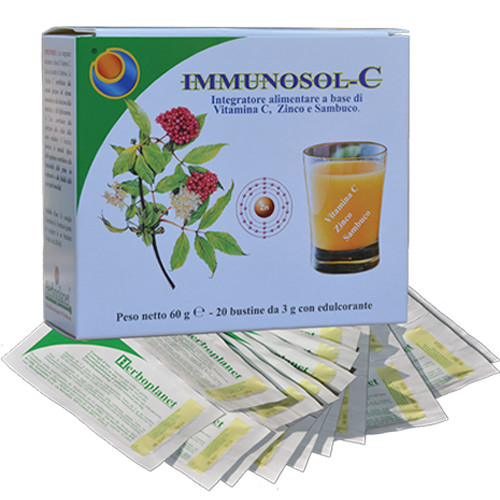
INTAKE OF INGREDIENTS FOR 1 SACHET OF 3 g: Maltodextrin, Vitamin C (L-Ascorbic Acid) 1 g, Zinc gluconate (contribution in zinc 10 mg – 100% NRV), Aroma, Elderberry fruit dry extract (Sambucus nigra L.) titrated 15% in Anthocyanins 50 mg (contribution in anthocyanins 7.5 mg). Sodium hydrogen carbonate, Anti-caking agent: Silicon dioxide. Sweetener: Sucralose.

IMMUNOSOL is a food supplement based on Vitamin C, Zinc and Elderberry extract.

VITAMIN C contributes to the normal function of the immune system and the reduction of tiredness and fatigue.

ZINC contributes to the protection of cells from oxidative stress.

Elderberry promotes the body’s natural defenses and contributes to the functionality of the upper respiratory tract and the fluidity of bronchial secretions.

DIRECTIONS FOR USE: We recommend taking 1 sachet a day to dissolve in a glass of water.

WARNINGS:  Keep out of reach of children under three years. Do not exceed the recommended daily dose. The product should be used as part of a varied and balanced diet and a healthy lifestyle.

Available in the best pharmacies, parapharmacies, herbalists.

[content_control roles=”webinar”]

Pathology

Antioxidant. Counteracts oxidative stress. It promotes the absorption of calcium and iron. Collagen formation for cartilage. Collagen formation for the skin. Fortifies the walls of arteries and capillaries. Functionality of the upper respiratory tract. Reconstituent. Supports the Immune System.

Notes

VITAMIN C belongs to the group of so-called water-soluble vitamins, i.e. those which cannot be accumulated in the body, but must be regularly ingested through food. Vitamin C, or ascorbic acid, participates in many metabolic reactions and in the biosynthesis of amino acids, hormones and collagen. Thanks to its strong antioxidant powers, it raises the barriers of the immune systemand helps the body prevent the risk of cancer, especially in the stomach, by inhibiting the synthesis of carcinogenic substances. Furthermore, its contribution is essential for the neutralization of free radicals. Vitamin C it is the most powerful antioxidant present in the blood plasma, increases the immune system and inhibits the release of histamine, a molecule that is released when you have an allergic reaction and that triggers the typical symptoms of an allergy, therefore it has an antiallergic action and helps reduce the symptoms of asthma, often associated with allergies. The benefits against bronchial hypersensitivity are also known. Several studies have suggested that Vitamin C helps control colds by shortening their course, thus also alleviating the symptoms of cold-induced asthma. In addition, other studies have shown that prophylaxis with 1 gram per day of Vitamin C can help reduce the duration and severity of respiratory symptoms (cold, sore throat, bronchitis), thus indicating that Vitamin C plays some role in the defense mechanisms of the respiratory tract. It was already known since the 1970s that ascorbic acid could affect the immune system. The effect on the production of some immunoglobulin isotypes has been recognized, for example, by Prinz et al (1). Numerous clinical tests have confirmed the anti-inflammatory effects of ascorbic acid in human volunteers, the intake of this after stimulation of the immune system by a bacteria or virus has been shown to cause multiple shifts of analyzed cytokines, leading to a reduction of IL- 6 and TNF-alpha (2). Webb and Villamor reported in their scientific paper that ascorbic acid supplements are convenient pharmacological tools for the modulation of adaptive and innate immunity. Supplementation of natural products containing ascorbic acid leads to inhibitory effects on influenza virus replication (3). Improves the assimilation of iron and calcium, fights free radicals, strengthens the walls of arteries and capillaries, contributes to the production of collagen that constitutes the structure of all tissues of the body (muscles, epidermis, blood vessels, bones, cartilage, teeth) and is necessary for their normal functions. A 2016 clinical test demonstrated, for the first time, that una bassa concentrazione di Vitamina C è collegata ad una riduzione delle prestazioni fisiche e ad un aumento dello stress ossidativo (4). The discoveries of scientists such as U. Weser, D. Seeber and R. Warnecke confirm the hypothesis, formulated in previous studies, that “the ZINC, trace mineral, is implicated in every aspect of the health of every living thing“. Zinc contributes to normal cognitive function, normal DNA synthesis, normal fertility and normal reproduction, normal vitamin A metabolism, normal protein synthesis, maintenance of normal hair, nails and skin. Zinc also contributes to the maintenance of normal testosterone levels in the blood, the maintenance of normal vision as well as the normal function of the immune system and the protection of cells from oxidative stress. The SAMBUCO (Sambucus nigra) it contributes to the body’s natural defences, to the drainage of body fluids, to the fluidity of bronchial secretions and to the functionality of the upper respiratory tract. Also not to be forgotten is its contribution to the regularity of the sweating process.

1). (Prinz, W.; Bortz, R.; Bregin, B.; Hersch, M. “The effect of ascorbic acid supplementation on some parameters of the human immunological defence system“. Int J. Vitam. Nutr. Res., 1977, 47,248-257.)
2). (Tan, P.H.; Sagoo, P.; Chan, C.; Chan, C.; Yates, J.B.; Campbell, J.; Beutelspacher, S.C.,; Foxwell, B.M.; Lombardi, G.; George, A.J. “Inhibition of NF-kappa B and oxidative pathways in human dendritic cells by antioxidative vitamins generates regulatory T cells.” J. Immunol., 2005, 174, 7633-7644)
3). (Jariwalla, R.J.; Roomi, M.W.; Gangapurkar, B.; Kalinovski, T.; Niedzwiecki, A.; Rath, M. “Suppression of influenza A virus nuclear antigen production and neuraminidase activity by a nutrient mixture containing ascorbic acid, green tea extract and amino acids.” Biofactors, 2007, 31, 1-15.)
4). (Webb, A.L.; Villamor, E. Update: “Effects of antioxidant and nonantioxidant vitamin supplementation on immune function.” Nutr. Rev., 2007, 65, 181-217.)
5). Randomized Controlled Trial Eur J Nutr . 2016 Feb;55(1):45-53. doi: 10.1007/s00394-014-0821-x. Epub 2014 Dec 20. “Low Vitamin C Values Are Linked With Decreased Physical Performance and Increased Oxidative Stress: Reversal by Vitamin C Supplementation
Vassilis Paschalis 1 2, Anastasios A Theodorou 2, Antonios Kyparos 3, Konstantina Dipla 3, Andreas Zafeiridis 3, George Panayiotou 2, Ioannis S Vrabas 3, Michalis G Nikolaidis 4 6). Cochrane Database Syst Rev. 2013 Jun 18;(6):CD001364. doi: 10.1002/ 14651858.
CD001364.pub4. “Zinc for the common cold” Meenu Singh 1, Rashmi R Das Affiliations expand PMID: 23775705 DOI: 10.1002/14651858.CD001364.pub4

[/content_control]
HERBOPLANET SRL
Via Rovescio, 165 - 47522 Cesena FC

+39 0547 353358

info@herboplanet.eu

HERBOPLANET ESPAÑA SL
C/ Monserrat, 16 - 08540 Centelles B

+34 93 1985828

info@herboplanet.es