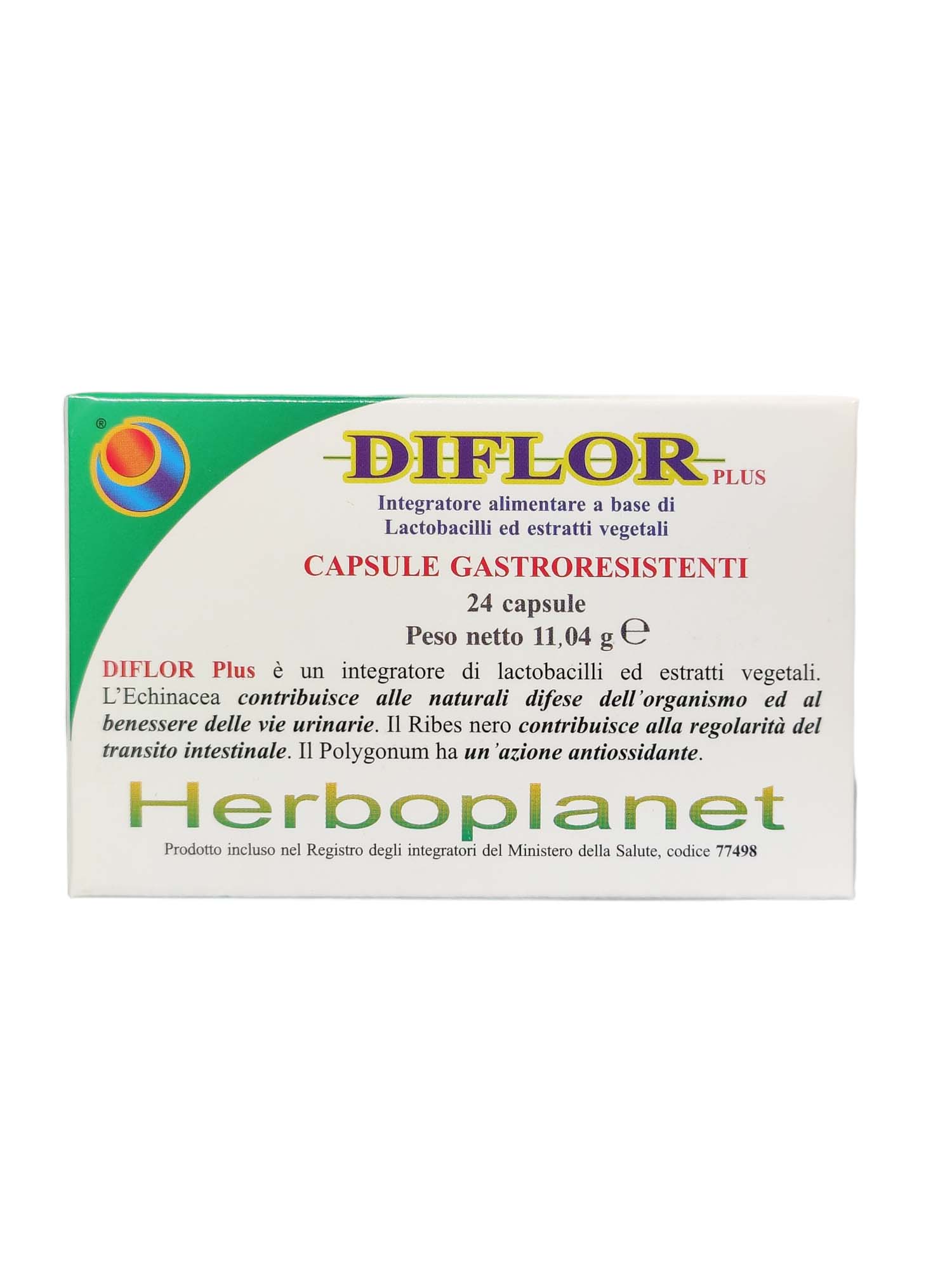
Product included in the register of supplements of the Italian Ministry of Health, code 77498.
INGREDIENT INTAKE FOR 2 CAPSULES: Echinacea dry extract (Echinacea angustifolia DC.) root 320 mg (contribution in echinacosides 12.8 mg), dry extract of Blackcurrant (Ribes nigrum L.) fruits 200 mg (intake in anthocyanosides 2 mg), Lactobacillus bulgaricus DSM 25567 lyophilisate 100 mg (Supply in live cells 2.5 billion), Bifidobacterium infantis DSM 26197 lyophilisate 50 mg (Supply in live cells 2.5 billion), Lactobacillus acidophylus DSM 24936 liofilizzato 33,4 mg (Supply in live cells 2.5 billion), Bifidumbacterium animalis ssp lactis DSM 25566 allergen free lyophilisate 16.8 mg (Supply in live cells 2.5 billion). Resveratrol titrated to 98% from the root of Polygonum cuspidatum Siebold & Zucc. 10 mg (resveratrol intake 9.8 mg). Anti-caking agents: magnesium salts of fatty acids. Total supply of living cells 10 billion. Food gelatin capsule. Contains milk derivatives.
GLUTEN FREE
DIFLOR PLUS is a supplement of lactobacilli and plant extracts.
ECHINACEA contributes to the body’s natural defenses and the well-being of the urinary tract.
BLACKCURRANT contributes to the regularity of intestinal transit.
POLYGONUM has an antioxidant action and contributes to the regular functionality of the cardiovascular system.
DIRECTIONS FOR USE: 1 or 2 capsules a day to be swallowed with water.
WARNINGS: Keep out of the reach of children under three years of age. Do not exceed the recommended daily dose. The product should be used as part of a varied and balanced diet and a healthy lifestyle.
Available in the best pharmacies, parapharmacies, herbalists.
[content_control roles=”webinar”]
Pathology:
Stimulant of the immune system, prevention of intestinal infections, antibiotic-associated diarrhea, diarrhea of travelers, childhood diarrhea, inflammatory bowel diseases, irritable bowel syndrome, colitis, intestinal dysbiosis, urogenital inflammation, Candida albicans, Helicobacter pylori, lactose intolerance, improves the absorption of minerals and vitamins.
Notes:
The initial observation of the positive role played by some bacteria was introduced by the Russian scientist and Nobel laureate Ilya Metchnikoff (one of the founders of current immunology), who at the beginning of the twentieth century suggested that it would be possible to modify the intestinal flora by replacing harmful microbes with useful microbes. Metchnikoff, at that time a professor at the Pasteur Institute in Paris, supported the idea that the aging process was derived from a putrefaction activity of microbes that produce toxic substances in the large intestine (proteolytics). Proteolytic bacteria such as clostridia, which are part of the normal intestinal flora, produce toxic substances, including phenols, indole and ammonia, products derived from the digestion of proteins that according to Metchnikoff are responsible for what he calls “intestinal self-intoxication“. cause of the physical changes associated with old age. It was at that moment that he noticed that the fermented milk from Lactic Acid Bacteria (from which the acronym LAB in English), was able to inhibit the growth of proteolytic bacteria thanks to the low pH produced by lactose fermentationand to regularize the intestinal tract, thus helping to eliminate annoying constipation. Based on these facts, Metchnikoff proposed the consumption of sour milk fermented with these bacteria, he himself included it in his diet finding an immediate benefit for health. Scientists believe that these bacilli can modify the intestinal flora, thus limiting the self-intoxication that is the cause of arteriosclerotic changes that lead to premature senility. At the beginning of the twentieth century, probiotics were studied to rebalance the intestinal environment by restoring its microbial balance, with consequent inhibition of pathogens and bacteria that produce toxins and improve the immune system on which the ability to defend ourselves from microbial diseases depends. Today, specific health effects have been studied and documented. such as the reduction of inflammatory bowel diseases, the prevention and treatment of pathogens that induce diarrhea (travel, childhood, antibiotics), urogenital infections and atopic diseases. The family of Bifidobacteria, and LAB (acronym of Lactic Acid Bacteria), are the most common types of microbes used as probiotics. Etymologically, the term appears to be a compound of the Latin preposition for (per) and the Greek adjective bioticos (biotic), the latter deriving from the Greek word BIOS (life). According to the definition currently adopted by the FAO/WHO, probiotics are: “Live microorganisms that, when administered in adequate quantities, confer a benefit on the health of the host“. Bacteria have multiple properties, including the inability to ferment sugar, except lactose from which they produce lactic acid. This ability is very useful for all those who suffer from lactose intolerance, since the digestive system no longer has the enzymes to break down lactose into simpler sugars. It seems almost established that the preparations of ECHINACEA (Echinacea angustifolia) slow down the spread of pathogenic germs in the tissues and trigger a defense mechanism against the aforementioned germs by simultaneously activating the regenerative mechanisms of the tissues. The active ingredient of this action would be a glucoside of caffeic acid and pyrocatechin that would have the ability to inhibit the enzyme hyaluronidase indirectly responsible for the attack of microorganisms, as well as their proliferation in tissues; the active ingredient would also have a direct action on the ac system. Hyaluronic-hyaluronidase which is activated by stimulating the proliferation of fibroplasts (The phagocytic action of echinacea…, in. Erb. Domani,2/91, p. 16). For this reason, echinacea preparations are considered effective in the treatment of septic states and infectious diseases accompanied by fever, especially when there is a manifested tendency to chronic relapses, moreover, the plant has anti-inflammatory and healing properties. The BLACKCURRANT (Ribes nigrum) It is the remedy for acute allergy, chronic gouty states and minor hyperazotemic renal failure. Every acute adynamic syndrome finds its indispensable remedy in Ribes nigrum to increase the corticosteroid rate. Its action is exerted at the level of the adrenal cortico, of which it seems to stimulate the secretion of anti-inflammatory hormones. Acting by direct stimulation of the adrenal cortex, it does not have the iatrogenic drawbacks of corticoids, it also does not cause drowsiness. It has a clear action antiallergic, it is indicated in all inflammatory states where the speed of sedimentation is very accelerated and in allergic cases, what is their clinical appearance: rhinitis, bronchitis, asthma, gastritis, migraines, urticaria, Quincke’s edema, allergic rheumatism. The RESVERATROLis a polyphenol found in grapes and other plants (eg Polygonum cuspidatum), is used by the plant to protect itself from pests. Today wine does not contain much resveratrol, indeed, there is almost no trace, this is due to the use of pesticides, therefore, to be able to take it, it is necessary to produce extracts that contain an adequate amount. Resveratrol is attributed many properties including antiviral, anti-inflammatory, anticarcinogenic and that of being able to prolong life. Resveratrol is an important supplement as able to regenerate glutathione levels, have a powerful antioxidant action, increase the levels of quinone reductase, an enzyme used by the liver to detoxify carcinogens and seems to be able to inhibit the onset, promotion and progression of certain types of cancer (prostate, colon, etc.). The World Health Organization indicates resveratrol as substance able to reduce cardiovascular risks by 40%. As an antioxidant it protects against a wider range of free radicals than vitamin E. Resveratrol promotes the production of nitric oxide, a biochemical mediator that living organisms produce internally in order to control many of their functions and which relaxes and dilates the arteries. Resveratrol inhibits platelet aggregation by blocking the action of thrombin, prevents the oxidation of low-density lipoproteins (LDL-cholesterol). A study published in the journal “Science” states that Resveratrol is able to block the proliferation of cancer cells during three important stages of development. In other studies it has been highlighted, for example, the ability of resveratrol to prevent certain types of cancer (e.g. those generated by bone metastasis) and to reduce skin cancer by more than 90%. Another study showed that Resveratrol can induce apoptosis in vitro in cancer cells and reduce the growth of cancer cells. Further research has shown that in some cases Resveratrol improved the results of chemotherapy treatments.
COMPLEMENTARY REMEDIES: ORTISA HP, DEFENSOL, METEORSOL, ENZYSOL, DIARSOL
[/content_control]