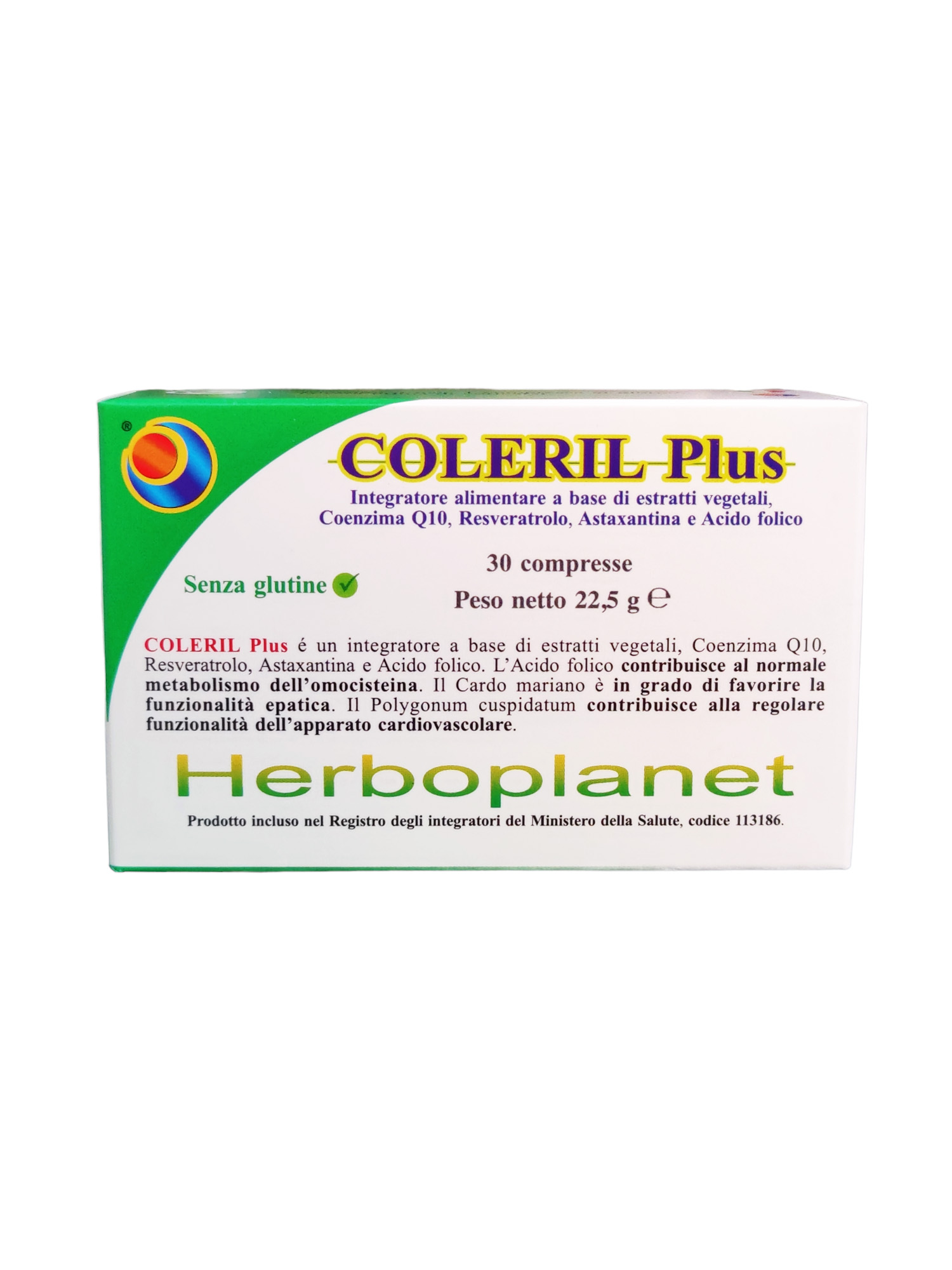
Product included in the register of supplements of the Italian Ministry of Health, code 113186.
HERBAL INGREDIENTS FOR A TABLET: DRY EXTRACT OF MILK THISTLE (Silybum marianum Gaertn.) fruits 200 mg (contribution in silymarin 160 mg), dry extract of fermented red rice (Monascus purpureus) titrated to 1.5% in Monacolin K 193.3 mg (contribution in monacolin 2.9 mg). Bulking agents: microcrystalline cellulose, gum arabic. Dry thallus extract of Haematococcus pluvialis Flotow. standardised to contain 2.5% Astaxanthin 40 mg (astaxanthin intake 1 mg). Bulking agent: calcium phosphate. Anti-caking agents: magnesium salts of fatty acids, silicon dioxide. Coenzyme Q10 10 mg, dry extract of Polygonum cuspidatum root Siebold & Zucc. 10 mg (resveratrol intake 9.8 mg), folic acid 200 μg = 100% NRV*. – *NRV: Nutrient Reference Values
GLUTEN FREE – FRIEND OF VEGANS
COLERIL PLUS is a supplement based on plant extracts, Coenzyme Q10, Resveratrol, Astaxanthin and folic acid.
MILK THISTLE is able to promote liver function.
POLYGONUM CUSPIDATUM contributes to the regular functionality of the cardiovascular system.
FOLIC ACID contributes to normal homocysteine metabolism.
DIRECTIONS FOR USE: 1 tablet a day, in the evening before going to bed.
WARNINGS: Keep out of the reach of children under three years of age. Do not exceed the recommended daily dose. For the use of the product it is advisable to hear the opinion of the doctor. Do not use during pregnancy, lactation and in case of therapy with hypolipidemic drugs. The product should be used as part of a varied and balanced diet and a healthy lifestyle.
Available in the best pharmacies, parapharmacies, herbalists.
[content_control roles=”webinar”]
Pathology:
Hypercholesterolemia. Hypertriglyceridemia.
Notes:
NOTES: The MARIAN CARDO(Silybum marianum) is particularly valuable in liver dysfunction. The fruits of milk thistle, improperly called seeds, contain an active ingredient called Silymarin that has a hepatotropic activity and it is for this reason that the Thistle enters into different formulations of products that boast this action. Silymarin corresponds to the set of three substances called stereoisomers (Silibin , Silidianine and Silicristine). Among the three stereoisomers , Silybin is the most active. Milk thistle has been at the center of numerous experimental works that demonstrate the antihepatotoxic activity of flavolignans (bioflavonoids) present among the active ingredients (Silymarin, Silidianine and Silicristine), only recently isolated. However, it is the term Silymarin that classifies flavolignans, the primary group of active chemical isomers of milk thistle. These molecules have shown a very strong hepatoprotective action against toxic substances such as alcohol and toxins of the Phalloid Amanita(phalloidin). Silymarin binds to the liver cells preventing the poisons of the mushroom from binding to it, thus blocking their poisonous effect. Silymarin is also able to neutralize the poison directly, which makes it effective even if taken after ingesting the poison of the mushroom. Laboratory tests and clinical trials have proven that Silymarin has an effect on the cell membrane of the hepatocyte preventing or making it very difficult for various toxic substances to penetrate into the liver (membranotropic activity), thus hindering the fatty degeneration and necrosis of the cell. The fruits of the Milk thistle have a regenerative action on the liver, they increase the synthesis of RNA by stimulating the activity of RNA polymerase, consequently accelerating the regeneration process of the liver parenchyma. Silymarin is able to intervene positively on lysosomal and mitochondrial lesions caused by ethanol and stimulate the protein synthesis also impaired in alcohol lesions. Milk thistle can help rejuvenate the liver and also protect it from any future damage, anyone who has had hepatitis, cirrhosis or other liver dysfunction should add milk thistle as a health component, in fact, it would not hurt if you habitually took it as a tonic and regenerating liver, for preventive purposes, or maintenance, to the extent of 200 mg of Silymarin per day. Silymarin is today not only the best documented substance for liver therapy, but also one of the most thoroughly researched and studied plant extracts with known mechanisms of action. Milk thistle as a tonic and regenerating liver helps in liver statosis, liver diseases from alcoholism, drug use, chronic hepatitis, liver cirrhosis, jaundice, sensitivity to chemicals, exposure to industrial toxins, detoxification programs. Regenerates liver tissue damaged by hepatitis, cirrhosis, alcoholism, drugs, and environmental toxins. It also helps against fatigue and food allergies. Silybin, a component of Silymarin, stimulates the activity of an enzyme, Super Oxide Dismutase (SOD), which acts as a scavenger of free radicals, much more powerful than Vitamin E. Milk thistle inhibits the lipoxigenase enzyme, preventing the formation of leukotrienes, components responsible for inflammation. The MONASCUS PURPUREUS is a yeast contained in Fermented Red Rice that has been used in Chinese nutrition and phytotherapy for centuries, in fact it is already mentioned in the ancient Pharmacopoeia “BenCaoGangMu-DanShiBuYi”, published at the time of the Ming dynasty (1368-1644 ). Several studies, more recently and precisely in the late 90s, have shown that Monascus Purpureus had among its active ingredients an inhibitor of HMG-CoA-reductase, an enzyme that controls the rate of cholesterol synthesis. Monascus purpureus contains monacolins and the most abundant is Monacolin K or Lovastatin, it inhibits 3-hydroxy-3-methylglutarylcoenzyme A reductase (HMG-CoA-reductase) which is the 21st step for cholesterol synthesis (Endo 1976). Without this enzyme, the entire sequence of cholesterol synthesis is blocked. Consequently, it represents an elective target for regulating blood cholesterol levels. In a recent clinical study (1997) the efficacy of Monascus Purpureus was evaluated continuously for 8 weeks by 446 hyperlipidemic patients. The enrolled subjects had elevated baseline blood values of total cholesterol, LDL-cholesterol or triglycerides; at the same time, reduced HDL-cholesterol values were detectable. The results obtained showed that the intake of Monascus Purpureus determines the significant reduction of cholesterolemia: –22% for total cholesterol (-7% for controls) and –30.9% for LDL-cholesterol (-8.3% for controls). In the same study it was found that Triglyceridemia was reduced by 34.1% and that there was a significant increase in HDL-cholesterol. The same results were obtained in another study (1999) involving 83 hyperlipidemic patients: Monascus Purpureus, used as a dietary supplement for 8 weeks, resulted in significant reductions in total and LDL cholesterol. Modern scientific research has confirmed that foods containing Monascus Purpureus really have the effect that tradition attributed to them. In Japan, the extract of the mycete Monascus Purpureus is administered to those people who are not very sensitive to dietary rules to regulate blood pressure, triglycerides, bad LDL/VLDL cholesterol and raise good HDL cholesterol, in particular it is indicated for those who produce too much endogenous cholesterol. After years of tests on thousands of patients treated with an extract of Monascus purpureus, they confirmed its validity and authorized the dietary trade of specific isolates of Monascus purpureus, to control blood pressure, triglycerides and cholesterol, especially for people who do not respond to any traditional dietary treatment. Modern clinical studies conducted on behalf of the “National Institute of Health and Nutrition” Japanese have scientifically confirmed that a food supplement based on aqueous extracts of fermented red rice by Monascus-type fungi improves blood circulation and contributes to the reduction of blood pressure in case of hypertension. On the basis of the most recent scientific literature, therefore, it can be said that integration with Monascus Purpureus, together with suitable dietary methods, is effective and well tolerated in the regulation of hypercholesterolemia and hypertriglyceridemia, lowers blood pressure and has good stomach and digestive capacity, by virtue of its high amylase content. COENZYME Q10 was discovered in 1957 by Crane in ox-heart mitochondria. It acts as a hydrogen transporter in the mitochondrial redox chains and is therefore important for the production of energy, it is an antioxidant and has a protective function against free radicals. It acts against the peroxides that attack collagen and elastin and is therefore effective against loss of elasticity and the formation of wrinkles. Coenzyme Q10 is synthesized by our body, but its production decreases with age. The daily requirement is estimated to be 5 mg, while the recommended supplement for those over 35-40 years is much higher than 20 to 40 mg. Since the HMG-CoA reductase which is involved in the synthesis of cholesterol also intervenes in the synthesis of Coenzyme Q10, those who undergo treatments to reduce cholesterolemia (statins) may have a reduction in the values of coenzyme Q10. Coenzyme Q10 does not improve performance, just make sure that there is no deficiency of the same, to avoid a drop in performance. Therefore, after the age of 35 , integration may make sense. Seaweed HAEMATOCOCCUS PLUVIALIS contains natural Astaxanthin , a carotenoid, organic pigment that is also found in phytoplankton and to a lesser extent in some fungi and bacteria. On the market there are different types of Astaxanthin, the one of chemical derivation, the one obtained from yeast and the natural one obtained from the Haematococcus Pluvialis microalga grown in Hawaii. Natural Astaxanthin has no levels of toxicity, as it is a completely natural substance and of which numerous studies have confirmed its absolute food safety. Natural Astaxanthin is obtained by pulverizing Haematococcus Pluvialis algae after their stay in maturation tanks exposed to the sun, where the sudden and curious change of color testifies to the reaction. The Haematococcus Pluvialis alga produces Astaxanthin to defend itself and survive the strong stress condition, in fact, it is able to keep the algae alive for a good forty years. One of the major applications of Astaxanthin in the medical field concerns its ability to counteract the harmful action of free radicals. Astaxanthin has a great antioxidant power, it is more effective than substances such as beta-carotene and vitamin E, universally considered antioxidant molecules, their beneficial qualities in contributing to the maintenance of health have been widely demonstrated. Experiments have been conducted to clarify the role of Astaxanthin in neoplasms and the data show convincing results and establish that Astaxanthin is not only able to modulate the progression of the disease, but it is a preventive and protective factor against the onset. The main difference between natural Astaxanthin and other antioxidants is that many of these are unable to penetrate the organs and tissues of the body. Thanks to its particular structure and esterified nature (with fatty acids at one or both ends of the molecule), Astaxanthin is able to reach the body in depth and in every organ (brain, heart, muscles, skin), fighting oxidation and inflammation, protecting them and optimizing their functions. The low molecular weight and high lipophilicity mean that Astaxanthin is able to cross the blood-brain barrier, exerting its effects on systems that are difficult to reach by other antioxidants. The RESVERATROL is a polyphenol found in grapes and other plants (eg Polygonum cuspidatum), it is used by the plant to protect itself from pests. Today wine does not contain much resveratrol, indeed there is almost no trace left and this is thanks to the use of pesticides, therefore, in order to be able to take it, it is necessary to produce extracts that contain an adequate quantity. To the Resveratrol many properties are attributed including antiviral, anti-inflammatory, anticancer properties and that of being able to prolong life. Resveratrol is an important supplement as able to regenerate glutathione levels, have a powerful antioxidant action, increase levels of quinone reductase, an enzyme used by the liver to detoxify carcinogens and seems to be able to inhibit the onset, promotion and progression of some types of cancer (prostate, colon, etc.). The World Health Organization indicates resveratrol as a substance that can reduce cardiovascular risks by 40%. As an antioxidant it protects against a wider range of free radicals than vitamin E. Resveratrol promotes the production of nitric oxide, a biochemical mediator that living organisms produce internally in order to control many of their functions and which relaxes and dilates the arteries. Resveratrol inhibits platelet aggregation by blocking the action of thrombin, prevents oxidation of low-density lipoproteins(LDL-cholesterol). A study published in the journal “Science” states that resveratrol is able to block the proliferation of cancer cells during three important stages of development. In other studies, for example, the ability of resveratrol to prevent certain types of cancer (e.g. those generated by bone metastasis) and to reduce skin cancer by more than 90% has been highlighted. Another study showed that resveratrol can induce apoptosis in cancer cells in vitro and reduce the growth of cancer cells. Further research has shown that in some cases resveratrol improved the results of chemotherapy treatments . FOLIC ACID It is able to reduce homocysteine, an intermediate product of the conversion of the amino acid methionine into cysteine and present in the blood, whose high levels are associated with a number of pathologies (cardiovascular risk, atherosclerosis, osteoporosis ). Hyperhomocysteinemia is now considered one of the most important cardiovascular risk factors. In case of folic acid deficiency, there is an increase in homocysteine. In order to use folic acid, the body must first convert it to tetrahydrofolate and then add a methyl group to form 5-methyl-tetrahydrofolate (folinic acid). After being absorbed in the intestine, folic acid is activated by the liver, which transforms it into folinic acid, distributes it to the various tissues or, possibly, deposits it as a reserve. Folic acid is essential to the life of man and many other organisms, even particularly simple ones such as bacteria. This substance, intervening in the synthesis of nucleic acids, is very important for cell growth and reproduction. Folic acid deficiency can affect the level of cholesterol as a substance necessary for the use of fats.
COMPLEMENTARY RMEDI: PROLIVER, EPATOSOL, EPASOL, BETAMIX
[/content_control]